






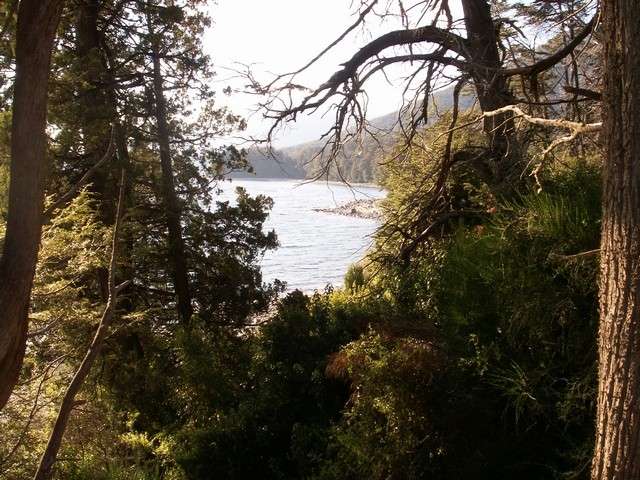


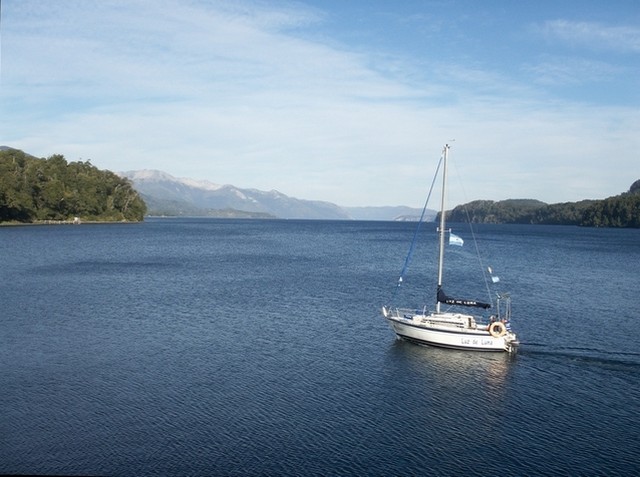
Our first foray into Patagonia was via a flight from Jorge Newberry Airport in Buenos Aires to San Carlos de Bariloche in the lower Andes Mountains. Bariloche is nestled in the "foothills" including Mount Tronador (which warranted its own page here due to the number of photos taken there) Cerro Catedral and Cerro Lopez, surrounded by the famous lakes including the vast Nahuel Huapi, Moreno, Gutierrez and Mascardi. This region is renowned for skiing, but it is a great summer resort, fine for water-sports, hiking, and everything outdoors (indoors too!). Mendoza page of Argentina 2007.
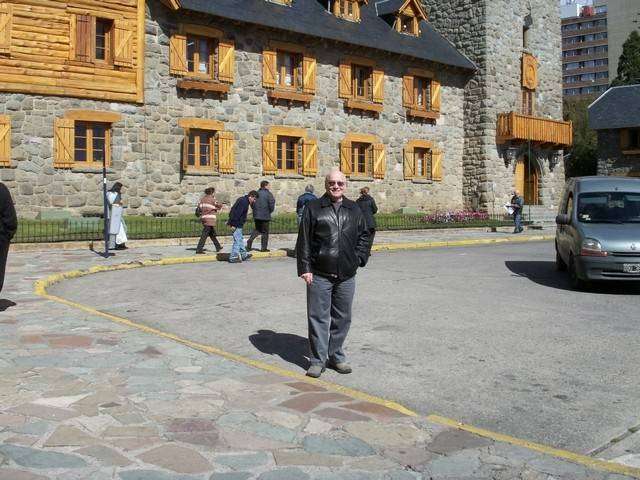
The European influence is evident in the architecture. Fine stonework combines with natural wood in wonderfully set chalets and villas. A jacket is necessary even though it is still summertime. The edifice shown at the left is just a couple blocks up from the shoreline of Lake Nahuel Huapi.
Lago Nahuel Huapi is a Glacial lake in northern Patagonia that has a surface area over 200 square miles. Many excursions originate in Bariloche, and we embarked on a day trip that took us to Puerto Blest, Puerto Alegre and the Chilean border.
Nahuel Huapi National Park is the first such created in Argentina in 1934, and the park encompasses almost 3000 square miles of unique forests, lakes, rivers, waterfalls, mountains, glaciers and much more. A small fee is charged for entry into the park, and we purchased day passes when we entered the park on our treks up Mount Tronador and our excursion across lake Nahuel Huapi and Lago Frio.
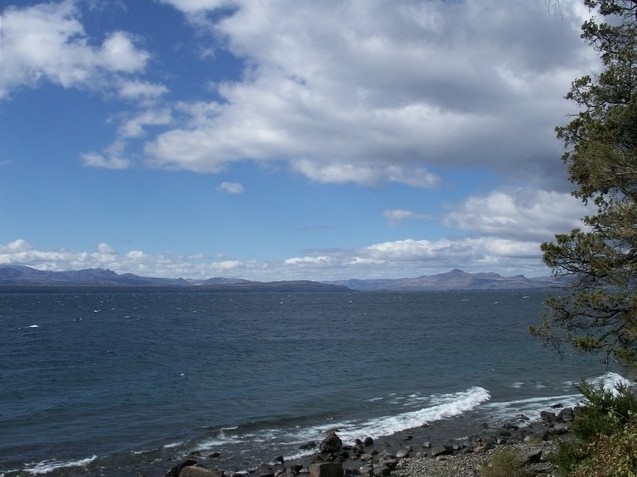
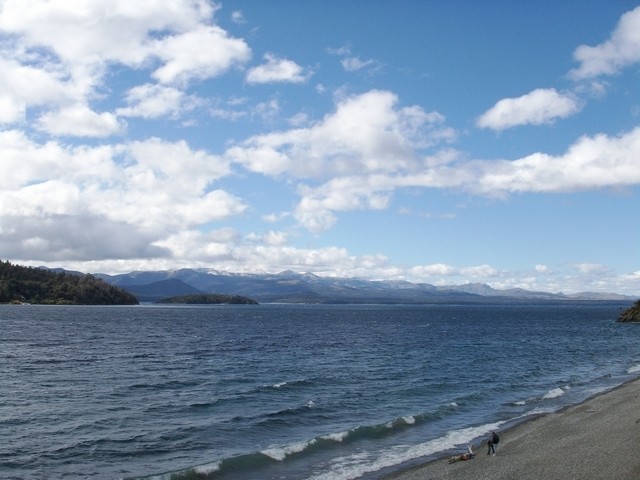
These photos cannot show the vastness of the lake, but the wave action is indicative of the size. The name comes from the language of the indigenous people, the Mapuche. Nahuel means tiger and huapi means island. I did not see any tigers, but I photographed some huge cat tracks on the trek up Mount Tronador. The wind is ever present or at least there is always a breeze. The fresh air is invigorating.
Bariloche ascends up the mountainside from the lakes edge. The primary area for tourist business is comprised of about three to four streets that run roughly parallel to the lakes shoreline for a distance of about fifteen blocks. All varieties of souvenir shops, clothing stores, sports (particularly skiing) paraphernalia suppliers, chocolate shops, cafes and parillas abound.
Hostels and hotels, and higher end restaurants are interspersed, too, but hotels and restaurants are also sprinkled around many other places outside this business section. Many restaurateurs and hoteliers take advantage of the lakeside vistas, or the marvelous mountainside overlooks.
One of my most favorite things is good, hearty coffee, and the folks take great pride in their coffee growing and brewing despite having Mate (mah-teh) as their national drink. I was disappointed only one time out of upwards of two-hundred, maybe more, partakings. That happened while waiting for the excursion boat out on the Llao Llao peninsula. There is a small, rudimentary souvenir shop - don't get coffee there! I was so spoiled by having so many fine tastings of espresso, latte, and other wonderful preparations.
Many cafes grind the beans freshly, and the aroma fills the air. Just walking along the streets is an olfactory expedition into the land of smoky fires cooking chargrilled meats, strong coffee, chocolate shop fumes, and, oh yes, don't forget the panaderias or bakeries with all kinds of different treats to whet the appetite and tease the imagination.
Sandrita awaits some of that fine coffee (left) in a streetside cafe. Note the napkins in the foreground. I got the biggest kick out of them. Paper is a precious commodity and those little napkins are about a quarter the size of napkins we're accustomed to. Many places have no paper at all - napkins or otherwise - and I quickly learned to always have some extra tissue stashed in my pocket
The lodge (left) at Casa Del Lago as seen from their "front" yard. The lower level at the right (in the picture) is a fitness/playroom with the open deck above. Behind the deck inside is the great room with the fireplace, and in the right hand corner is a small dining room. One day while I wandered around I met an Argentine family gathering of about fifteen or twenty people. One gentleman spoke some english, and we had some pleasant conversation in spite of my lack of linguistic skill. The folks were wonderful, and had many questions about the United States. They were very kind and wanted me to sit with them and share their wine.
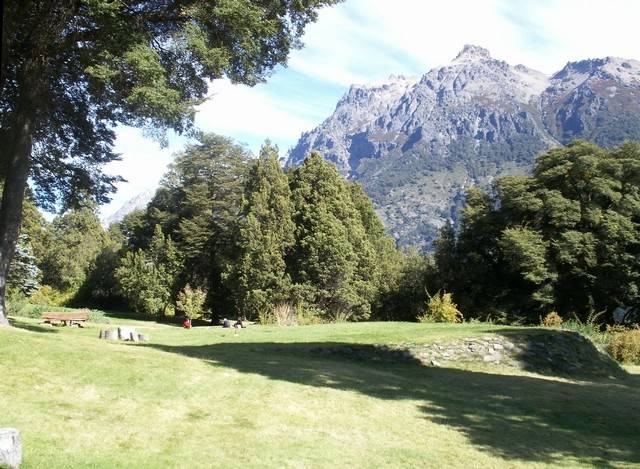
Mount Tronador (left) as seen from the same position facing approximately west in the front yard at Casa Del Lago. Visit the Mount Tronador page for the up close pictures and stories.
Lago Gutierrez (left) also taken at the same time in the same place from the front yard of Casa Del Lago. Facing approximately north this vista is essentially the same postcard view to be seen from inside when in the front rooms of the lodge.
The town of Bariloche is at the far end to the right in these photos, and the great lake, Nahuel Huapi is beyond that on the other side of the town. It is breathtaking to behold so much variety and scenic beauty from any place there.
This large bird sat perched outside the upstairs room. I thought it was a baby in spite of its large size. He let me get pretty close for this shot.
Weary and worn from climbing and hiking, on our last day in Bariloche we opted to chance the little rental car on a trip up the east coast of Nahuel Huapi to see how far we could get.
We did so much, but wanted to do so much more sightseeing and adventuring. The highway looked good on the map, so we headed into Nahuel Huapi National Park and up to the north side of the lake to the beautiful Villa La Angostura. Each turn of the head or at each turn there are more photo-ops. The territory is incredible.
We reached Villa La Angostura quite late in the afternoon. We drove around the town a bit looking for great vantage points for more pictures, while taking in all the sights.
Once again we were very close to the Chilean border, and I really wanted to include a bit of that country in the trip too, but we'd had a couple flat tires (see the Mount Tronador story) during the week, and learned one could easily be stranded for a long time without help, so we wanted to get back to our quarters before it got too late.
Casa Del Lago is roughly 20 kilometers south of Bariloche proper overlooking the scenic Lago Gutierrez. By this time we'd debated what might be the best mode of travel since there were considerable distances between our proposed destinations - we wanted to get close to a glacier, to see fantastic waterfalls, and to climb and hike in the Andes to absorb as much of the grandeur and culture as possible in one week. We opted to rent a car at the airport, and began that experience. There were a couple rental company booths in the terminal, but we soon determined that only one could fulfill our needs. After the usual negotiations and some waiting the one-man company came to help us take our luggage to the waiting vehicle. It was typically small, and we knew right away that the luggage for three people would not fit, so we went back inside and renegotiated for their larger car.
We'd also learned that there no "automatics" in Argentina - all such vehicles rely on manual transmissions. Hence, I would be the designated drive for this week. Eventually we were on our way with dear Sandrita's head full of information, directions and more, since she was our interpreter. Fortunately there was only one main road out of the airport, which is located just below the south shore of Lago Nahuel Huapi, and driving down highway that gave us time to try to orient ourselves for the trip into Bariloche then out again into the countryside to Casa Del Lago.
We came to the end of that road and had to turn west to head into town, and then head back out of town along the eastern shoreline of Lago Gutierrez to get to Casa Del Lago at the southern end of that lake. The major highways are fairly well constructed, and some of the main streets in Bariloche are paved and there are sidewalks and curbs in the primary tourism area. Nevertheless we ended up on some dirt streets as we sought out the route through the city to the highway at the south side.
Once away from the small downtown area we passed through some very poor barrios with shanties and rundown buildings of all types, but we found our major highway that took us to Casa Del Lago. Sandrita was watching, and it was a good thing, because it was dark now,and there was just a small sign and a light to catch our attention. All along the way we saw local people waiting for the autobuses to take them to or from their work.
Casa Del Lago is located up a a large dirt driveway, and is comprised of a few different buildings. The main one that I decided to call the "lodge" had a crushed stone parking lot with a few cars with license plates from Chile and other countries. We parked and started the next phase of our adventure. The lodge housed the managers office so we entered through a large wooden door into an anteroom beyond which was a large gathering room with a grand stone fireplace. Some embers from an earlier fire were smoldering in the hearth. There was a nip in the air in spite of the fact that it was summertime.
The office was a short way down a side hall, and before long Matti(Matilda) appeared. Sandrita signed us in, and Matti led us up the hill to another two story building of habitations. Our quarters on the second floor were small but adequate. It was essentially one room with a very high ceiling. Just inside the door to the right an open stairway led up to an open loft that was just large enough for a bed. We hauled our luggage in, fit it under the stairway, and began to settle in and unwind from all the traveling. The room had a sofa that could be used as a bed, a small dining table with chairs, a counter in the back with a stovetop, and a small refrigerator. The bathroom was just to the left. Our time in this room was going to be very intimate for the next week.
It was later than 10 pm, dark and chilly outside, and I was still wound up from the flight and the drive, so I decided to take a walk outside. Sandrita suggested that I talk to Matti to learn about the area, what day trips might be practical, where to eat, etc. I walked a bit and went back to the lodge and the office. Matti is a lovely Argentine woman who helps to manage the resort. She speaks several languages, and even though her english was not strong we managed to converse adequately. I asked her about the area and day trips, and she told me to wait a while for Marlon to come. She said he would be better able to advise me about these sightseeing and hiking. Then I asked Matti if there might be another room available for the week. She opened a looseleaf binder with the schedule, and gave me the nod. The price was quite reasonable, so I booked the room. A bed would be much better than the couch.
Marlon

Marlon & Matti showed up and Matti disappeared to go prepare my new quarters.

quarters. Marlon, an affable young man, relaxed behind the big desk and spoke perfect english. His father was from Miami, his mother is Argentine and he is multilingual. He sipped from a strange cup through a metal straw as we spoke. He told me how to drive to Mount Tronador, and gave me brochures for certain restaurants in town including the El Boliche de Alberto

El Boliche de Alberto where I later in the week enjoyed some of the best lasagna I ever had.
Marlon took another sip from the strange cup and asked me if I had tried any "mate" yet. Mate,
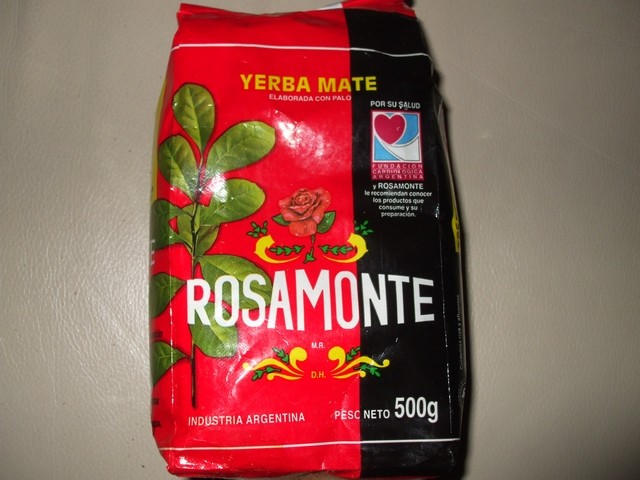
Yerba Mate the national drink in Argentina and other South American countries, comes from the leaves of the ilex paraguiensis, a cousin of our evergreen holly tree. Mate drinking is a ritual that is shared with friends, when the matero fills a dried, hollow gourd

Mate Gourd & Bombilla with the tea leaves, then introduces hot water. The mixture steeps and the drinking tube known as the bombilla is carefully placed deep into the tea mix and the mate gourd is passed for everyone to have a sip. The bombilla placing is an art itself that is intended to keep the fine leaves from being sucked up.
Marlon topped the gourd he'd been sipping from with hot water, and passed it over to me. I took my first sip of mate, and got a small mouthful of the leaves. Marlon smiled and said you have to be careful with the first sip. The leaves have to settle, and the bombilla has to nestle in so that the bits aren't sucked up. I can do that now. Marlon told me that some folks like to sweeten it since it is normally bitter. I recognized that this was a very friendly gesture by Marlon and we chatted for a while.
It was getting late so I headed back to the room and shared the new information with Sandrita and Erek. I told them about my good fortune obtaining my own separate quarters, and moved my luggage there. We settled in for the night.