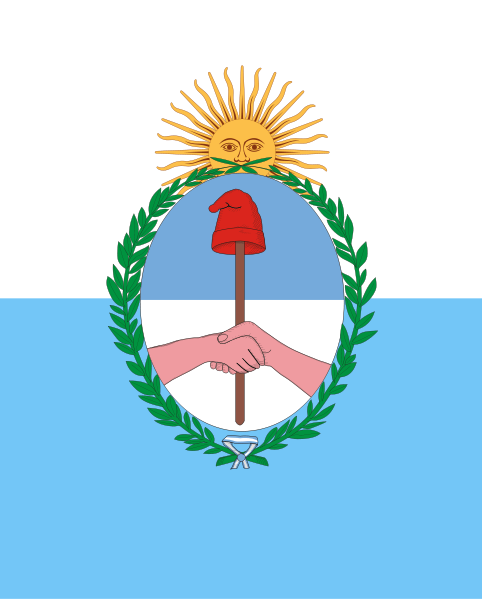

Mendoza's Coat of Arms.
Mendoza City is clean and orderly, with charming pedestrian walkways, arbors, sidewalk cafes, tree-lined streets and many green plazas of distinctly different architectural styles. It is known for it's historical district, its many churches, museums and cultural centers, and its parks. Of special note is the renowned Parque General San Martin, which is crowned by the nationally known historical monument Cerro de la Gloria. In the outskirts of the city are Mendoza's famous vineyards and wineries and such historical sites as El Plumerillo, the campground of General San Martin's Army of Liberation.
Parque General San Martin. This park is the biggest and most beautiful of Mendoza. It was designed by french architect Carlos Thays, and opened in 1906 (although its origins go back to 1896). The park has beautiful streets and avenues surrounded by hundreds of species of plants and trees. Inside the park there are several fountains, sculptures, gardens, and even the Mendoza zoo, which is worth visiting. There's also an artificial lake next to the Rosedal, which is used by the Mendoza Boat Race Club (Club de Regatas de Mendoza).
Plaza Independencia. (with the reddish paved sidewalks) This huge square was projected as the center of the new city after the earthquake that destroyed Mendoza in 1861. Surrounding it and in an equidistant way, four squares complete the matrix: San Martin, Chile, Italia and Espana. Its multiple species of trees and plants are identified with its respective scientific names and the names that are normally used. Weekends are scenario of the artisan fair that every now and then are enriched with the presence of some shows. Bellow the central stage, a great saloon shelters the small Municipal Julio Quintanilla theater and the Municipal Modern Art museum with painting exhibitions and contemporary sculptures. On the west end of the square is the coat of arms of the Province of Mendoza. It has a 16-meter diameter and has 3200 color lamps that form the provincial coat of arms. This symbol was donated by the mayor of the Capital Federal, Carlos Alberto Pueyrredon and since 1937 it remained in the Caballitos de Marly roundabout, at the Parque General San Martin, and was moved in 1942 to the Plaza Independencia, where it has remained until now.
Fuente de los Continentes (Continents Fountain). This fountain is located in front of the Rosedal in the San Martin Park. It was probably placed there around 1911. Although the sculptor is unknown, it is thought to have been a follower of Carpeaux. The fountain only shows four of the continents: America, Asia, Europe and Africa. Oceania was still considered a part of Asia. It is a circular 19.5m in diameter fountain, and in its base can be read the names of the four continents in french.
Elevation extremes: lowest point: Laguna del Carbon -105 m (located between Puerto San Julian and Comandante Luis Piedra Buena in the province of Santa Cruz) highest point: Cerro Aconcagua 6,960 m (located in the northwestern corner of the province of Mendoza)